As much territory as our trip covered, we saw only a small sliver of the central part of a vast country. The map below shows the vastness of Iran–the highlighted city names show the area that we visited.
-
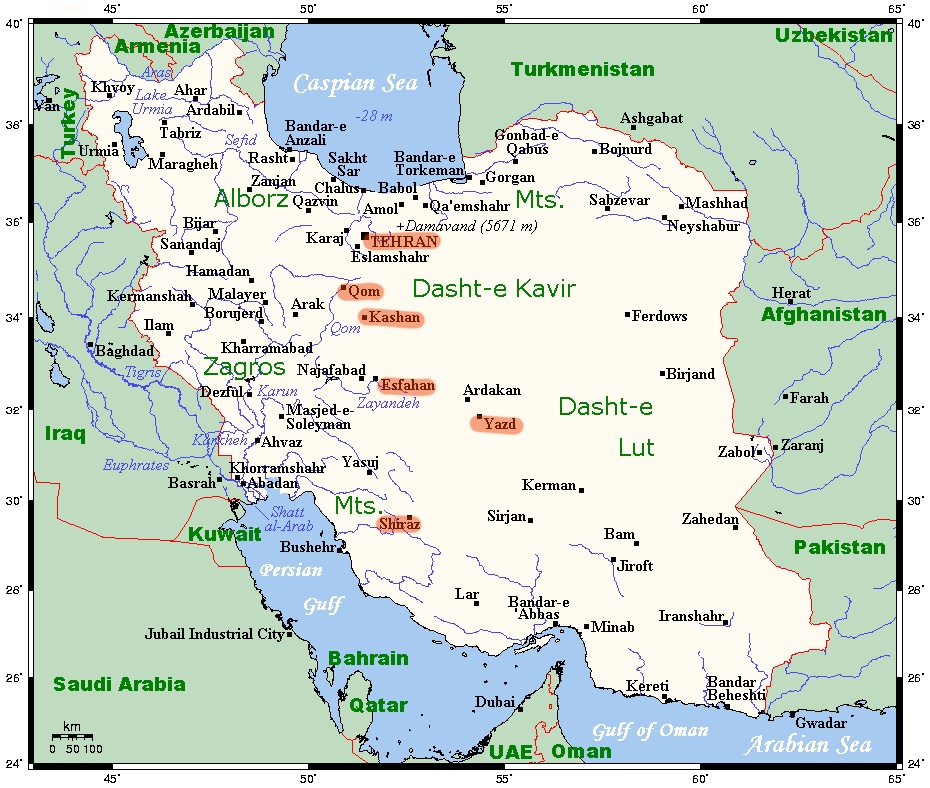
Map source: https://www.wikiwand.com/en/Geography_of_Iran
The area of Iran is 636,372 square miles (1,648,372 square kilometers). To get a sense of scale, Iran’s area is only slightly smaller than Alaska’s 665,384 square miles, but somewhat larger than the combined areas of Texas, California, and Montana (579,329 square miles). Another comparison: Iran is only slightly smaller than the 662,211 square miles of France, Germany, Italy, and Spain combined.
The topographical map below (click to enlarge) shows the terrain: mostly mountains and desert, without much fresh water (according to Wikipedia, only .73% of Iran’s area is water). There are no large rivers, and very few lakes of any size.
-
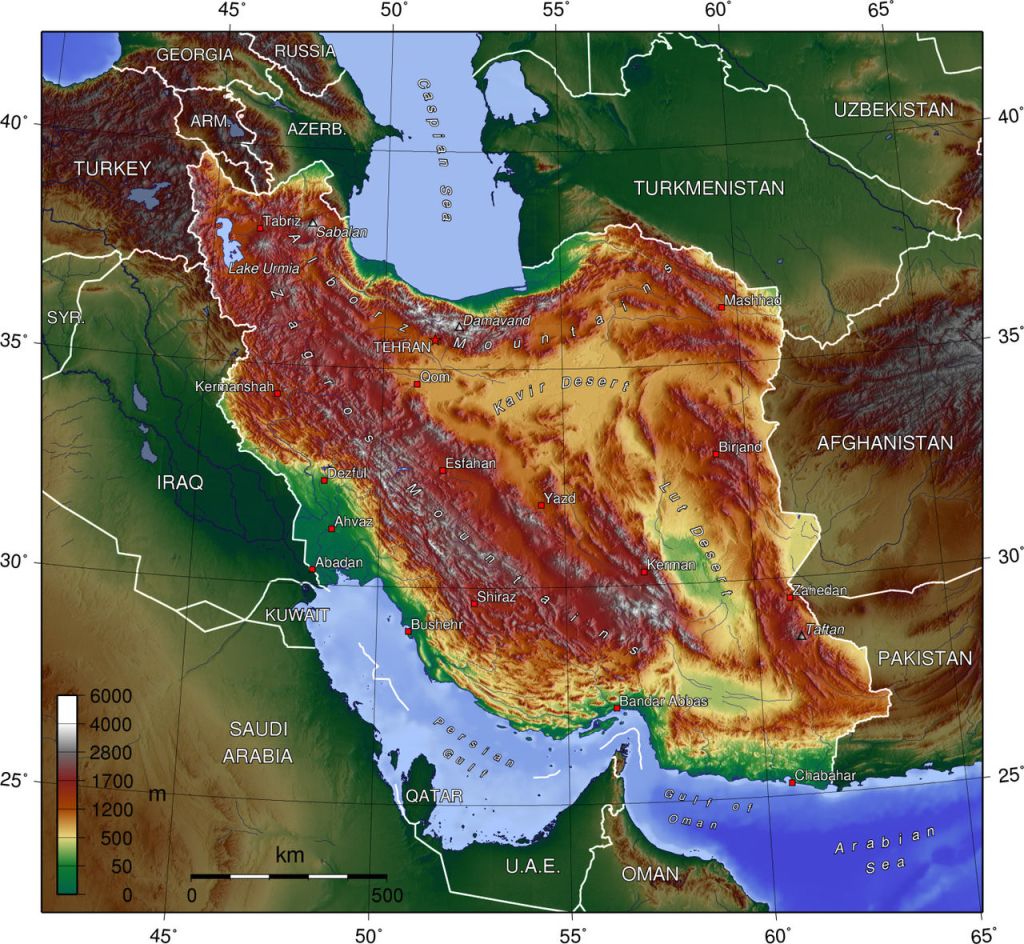
Map source: https://www.wikiwand.com/en/Geography_of_Iran
Historical Maps
Over the centuries and millennia of Iran’s/Persia’s history the borders have fluctuated greatly. Tim’s lifelong interest in history led him to seek out some historical maps of Iran which are shown below. Their source is: https://commons.wikimedia.org/wiki/Atlas_of_Iran
This map shows the empire of the Medes ca. 600 BCE. The Medes and Persians were among the ancient Iranian peoples. The Median kingdom lasted until 649 BCE, when it was defeated by the army of Cyrus the Great and absorbed into the growing Persian kingdom.
-
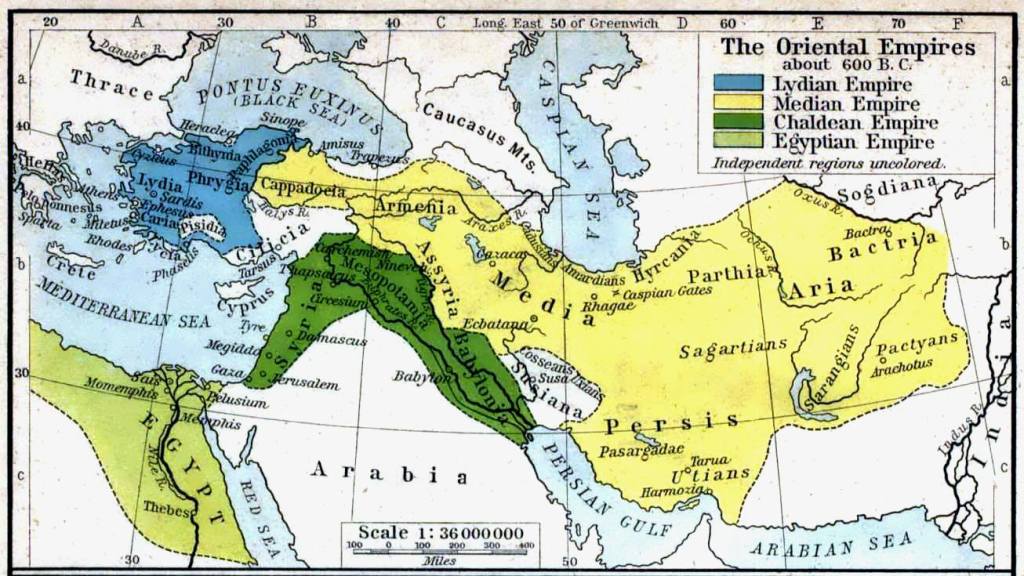
Western Asia before Cyrus the Great
The empire of Cyrus expanded rapidly–within a century of the defeat of the Medes, the territory of the Persian Empire of the Achaemenid Dynasty looked like this in the first half of the fifth century BCE.
-
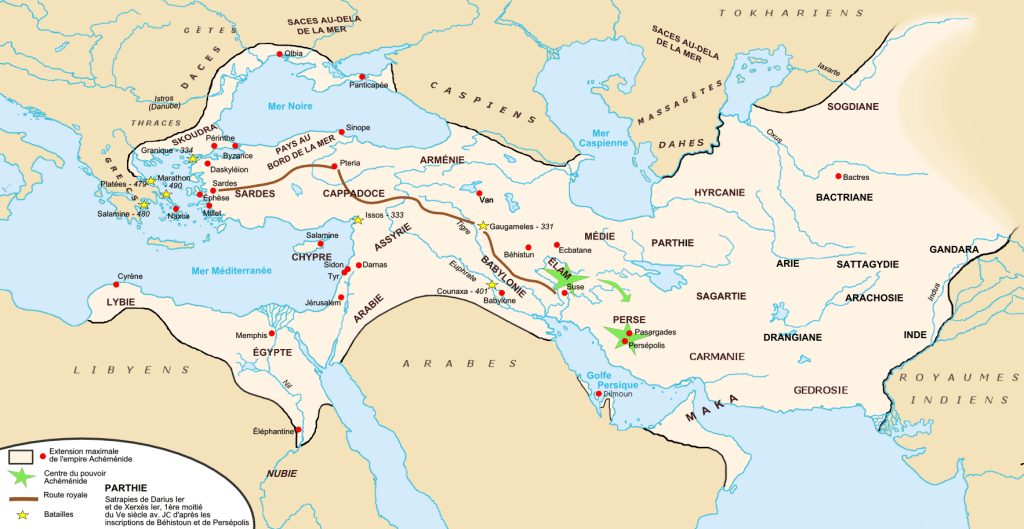
Achaemenid Empire at its greatest extent
This was the empire which the armies of the Greek city states defeated in the first two decades of the 5th century BCE. A David and Goliath battle if ever there was one! Within living memory of these wars, the Greek historian Herodotus (sometimes called the Father of History) wrote a massive history, not only of the wars themselves but also of the various peoples and places in the Persian Empire.
Vast at it was, the Achaemenid Empire did not endure. In 330 its Great King, Darius III, was defeated by the army of Alexander the Great and its territory became part of his short-lived empire. After his death at the age of only 33 in 323 BCE, his generals carved up his conquests to look like this:
-
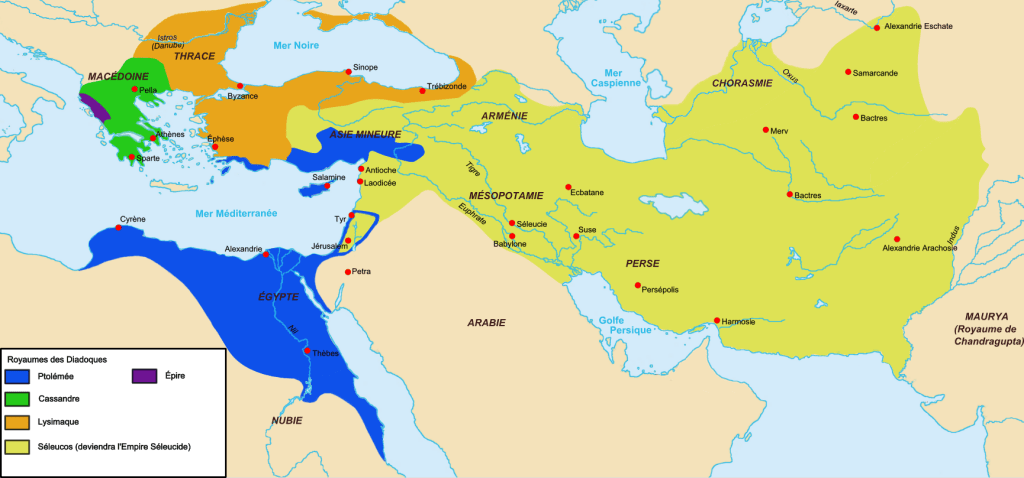
The empires of Alexander’s successors (the Diadochoi). Seleucus got the largest portion, including all of modern Iran and much else.
Unfortunately for Seleucus a tribe called the Parthians quickly overthrew the Greek rulers who had followed Seleucus and established an empire of their own that last for nearly half a millennium. They were engaged in a series of wars with the Romans for more than 250 years.
-
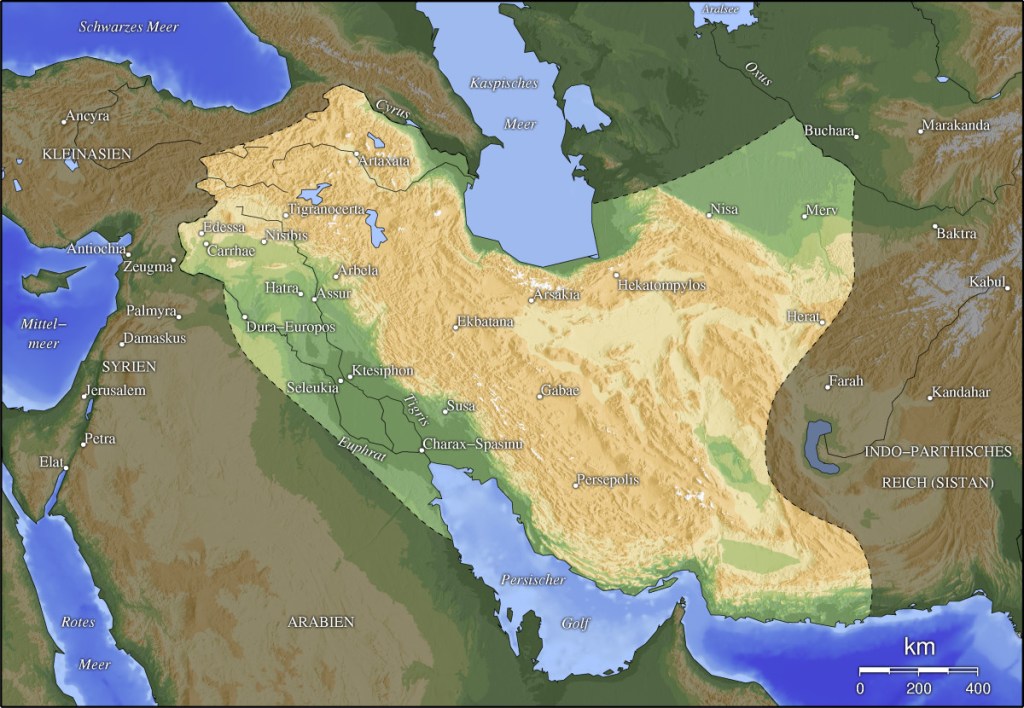
The Parthian Empire (247 BCE – 224 CE)
Weakened by the series of wars with Rome, the Parthian Empire finally fell in the third century CE. The Sassanid Empire, which succeeded the Parthians, was the dominant force in the region until the Arab Conquest in the 7th century. There is a large relief sculpture at Naqsh-e Rostam depicting the Sassanid king Shapur I holding captive the Roman emperor Valerian. The Sar Yazd fortress which we visited was active during this era of Persian history.
-
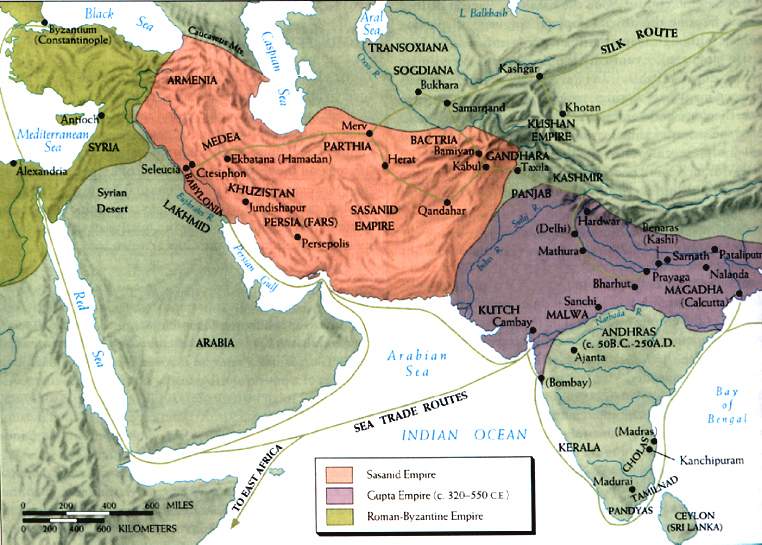
The Sassanid Empire and its neighbors
Beginning in 632 CE (the year of Mohammed’s death), Arab tribes made their first forays into the territory of the Sassanids. Weakened by years of wars with the Byzantine Empire, the Sassanid forces were decisively defeated by Arab tribes in 651CE. This had enormous consequences for Persian history and culture: within a couple of centuries Islam became the dominant religion, and the Arabic writing system was adapted to the Persian language and is still in use today.
Between the 7th and 15th centuries there was numerous dynasties–both Persian and ethnic groups–competing for territory and influence.
-
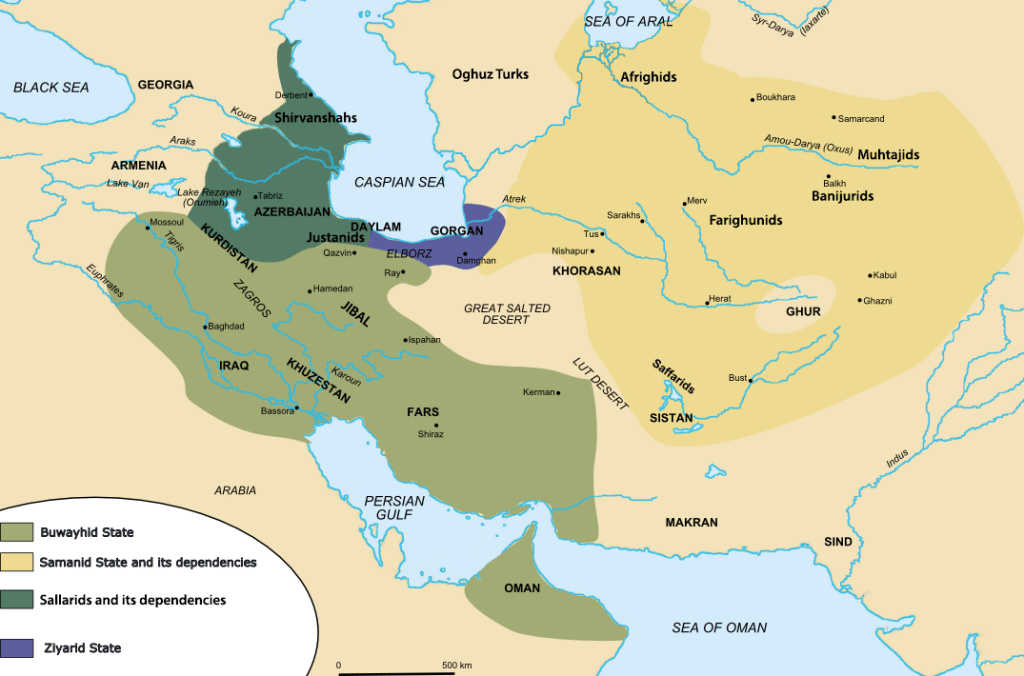
Area of Iran ca. 1000 CE. Note the number of separate Iranian kingdoms.
The Iranian kingdoms were among the numerous conquests of Genghis Khan, who added Persia to his dominions in the years shortly before his death in 1227 CE.
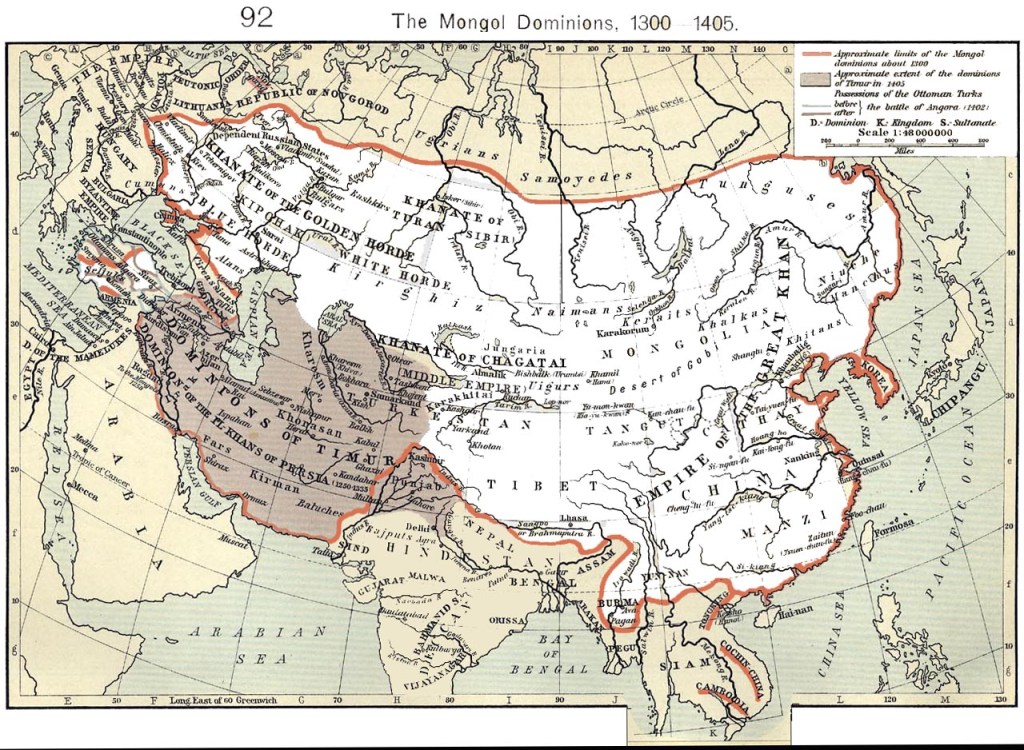
The southwestern section of the Mongol empire is sometimes known as the Ilkhanate, which eventually collapsed in the middle of the 14th century CE.
-
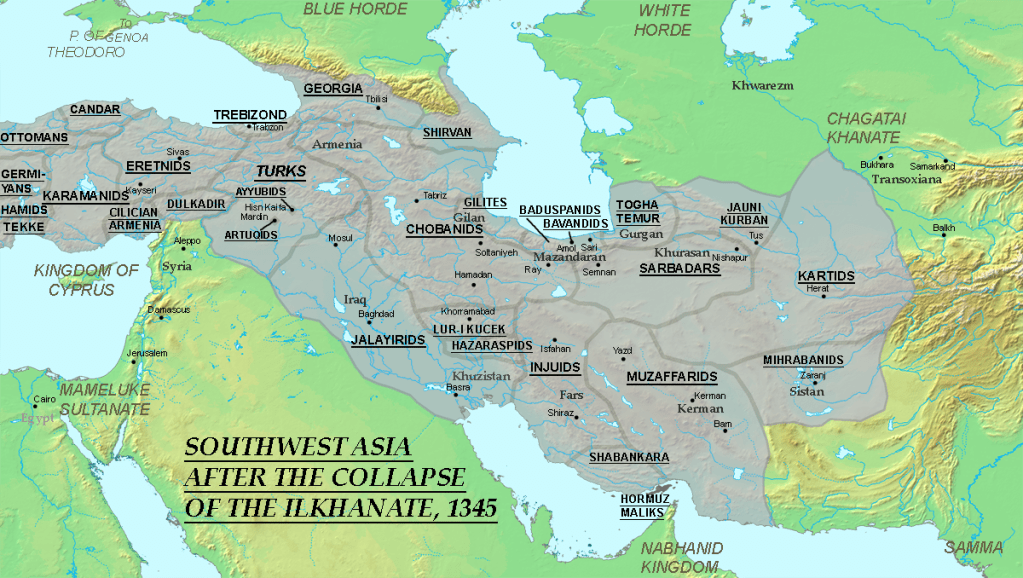
Many smaller kingdoms arose after the fall of the Mongols.
The Safavid Dynasty came into power in 1501 CE and continued as rulers of Persia for well over 200 years. Many of the sites we visited on this trip were built in this era. Also notable is the conversion of Persia to Shia Islam during this time–a decision that has had a profound impact on modern geopolitics.
-
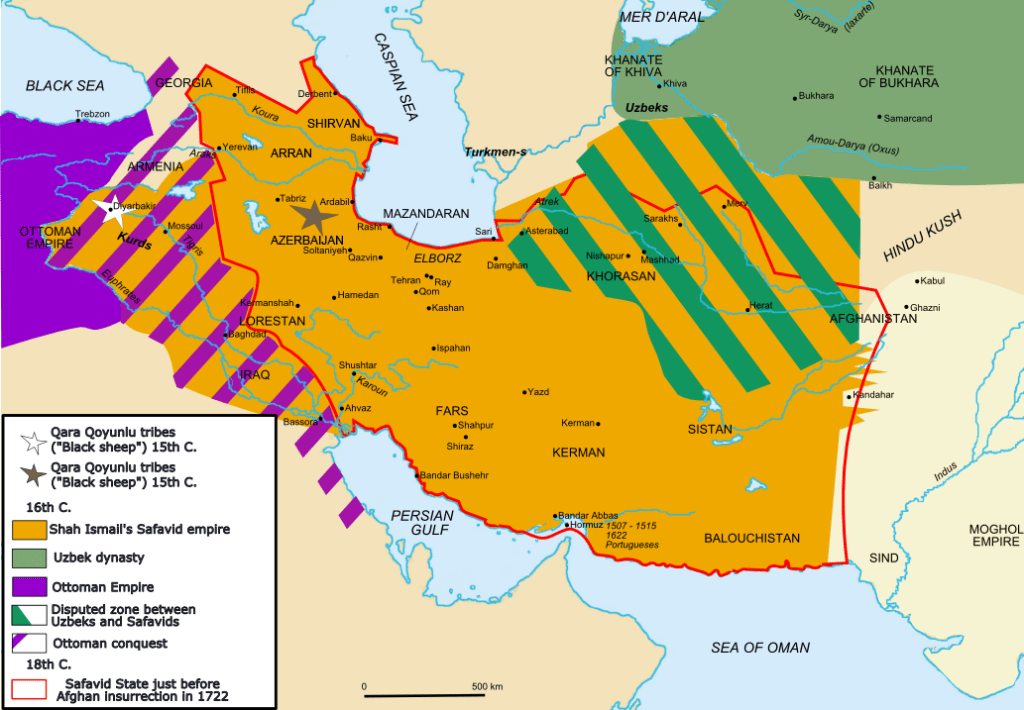
Iran at the time of the Safavids
Several short-lived dynasties followed the end of Safavid rule in 1736. By the end of the 18th century the Qajars came to power and remained Persia’s ruling family until 1925. At the end of the 19th century Qajar Persia’s borders began to look somewhat like they are now. On the map below, note the lines demarcating British and Russian areas of influence. This period marks the beginning of the foreign exploitation of Persian oil, which has continued to this very day.
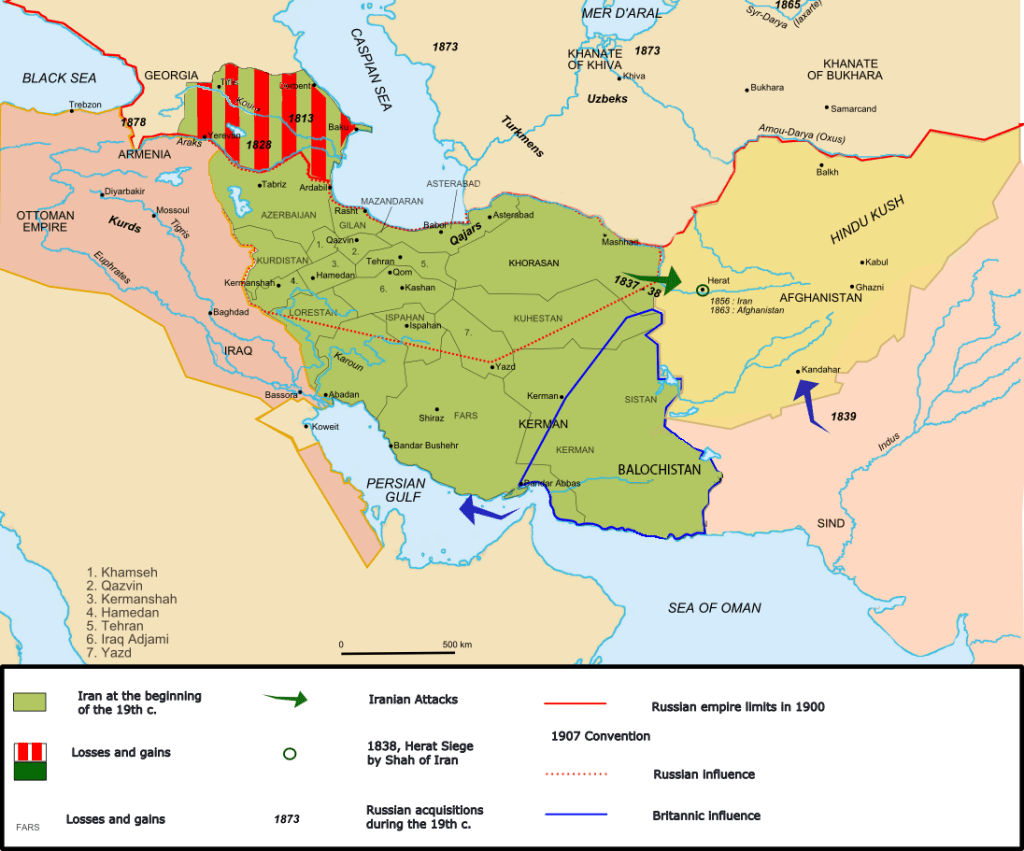
 Trip to Iran - November 2019